Your Complete guide about New Dubai Metro Stations.
Two apartments can look equally convenient on a map. One has a straightforward walk to a Metro entrance; the other requires a taxi because a major road blocks the direct route. For the person living there, the difference matters every morning.
That is the practical question behind Dubai’s latest transport headlines: will a new station make a particular property easier to live in and is that benefit already reflected in its price?
The Roads and Transport Authority’s assessment of the Blue Line includes a potential increase of up to 25% in the value of land and properties near its stations, set out in the official project announcement of June 2025. This is a project-level expectation, not a guaranteed return for a buyer. Official Blue Line announcement.
The useful starting point is to understand what that expectation can and cannot tell you about an individual home.
What Could a Transport-Related Increase Mean for Your Property?
Land value, an apartment’s selling price, and an owner’s investment return measure different things.
A development plot may become more attractive because improved access supports future uses. An existing apartment must still compete on its layout, condition, service charges, building management, and purchase price.
An owner’s eventual return also depends on income, expenses, financing, and the price achieved when selling.
The project’s estimated uplift should not be treated as:
- An annual growth rate.
- A guaranteed increase for an individual apartment or villa.
- A percentage to add automatically to today’s asking price.
A more useful question is whether better transport access could strengthen demand for the specific home you are considering.
Dubai Metro Expansion: The Current Picture
The Blue Line has an established official route. RTA describes a 30-kilometre project with 14 stations, scheduled for completion in 2029, linking into the existing network at Creek and Centrepoint. The project’s foundation stone was laid in June 2025. RTA project information
For buyers comparing locations, the distinction between the existing network and a future connection matters:
| Transport situation | What you can assess | What still needs care |
|---|---|---|
| An operating station | The actual walk, available services, and your door-to-door journey | Whether the asking price is justified by the property and its access |
| A planned Blue Line connection | The published route, project scope, and 2029 completion target | The exact entrance, eventual pedestrian connection, and conditions before opening |
| Another proposed connection | The current official announcement and its stated project stage | Whether a station, access arrangements, and opening timeline have actually been established |
For any other rail proposal, establish its status separately. A line being studied, an announced route, and a station under construction represent different levels of certainty.
Which Areas Deserve a Closer Look?
The official Blue Line route provides a starting point for research. It includes Dubai Creek Harbour, Dubai Festival City, Ras Al Khor, International City, Dubai Silicon Oasis, Academic City, Mirdif, and Al Warqa.
However, inclusion on a route does not make every building in a community equally accessible. Use the following questions to narrow a search; this is a comparison framework, not a ranking of expected returns.
| Area to investigate | Question to ask about the property |
|---|---|
| Dubai Creek Harbour and Dubai Festival City | Will the planned station entrance be practical to reach from this particular building? |
| International City | How do walking access, building condition, and ownership costs compare across the shortlisted properties? |
| Dubai Silicon Oasis and Academic City | Would the eventual journey suit the workplaces or institutions relevant to likely residents? |
| Mirdif and Al Warqa | Would residents walk, use a feeder service, or still need to drive to the station? |
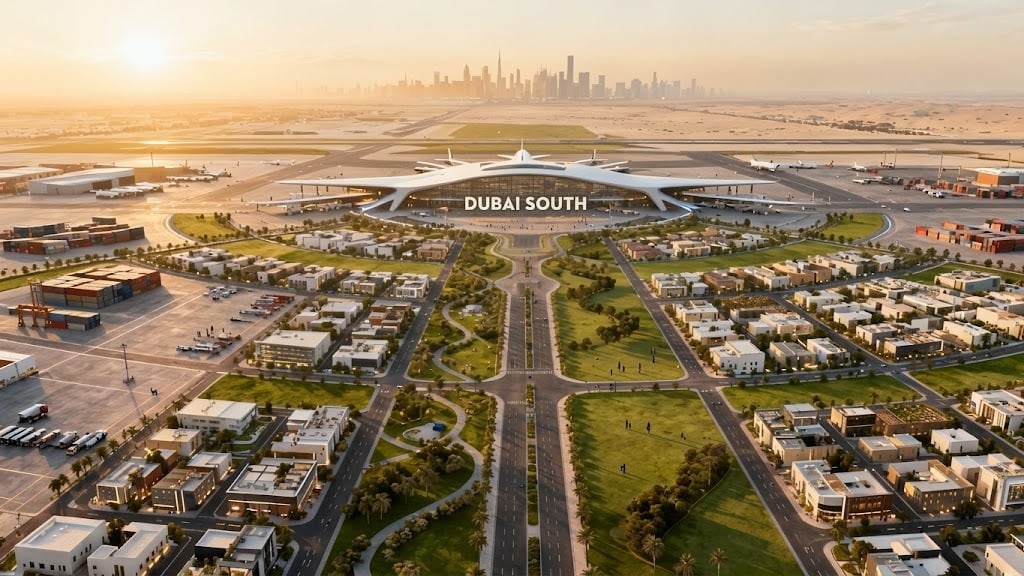
The same discipline applies when considering Jumeirah Village Circle or Dubai South: assess the community today, then verify any claimed future transport benefit at the property level.
A reference to a future corridor should never substitute for evidence of a station and a usable connection to it.
How Better Metro Access Could Help a Property
The strongest case for a transport premium begins with everyday usefulness.
For a tenant whose workplace is accessible by rail, a convenient station may reduce the need to drive. For an owner-occupier, it may offer another way to manage commuting, shopping, or visits across the city.
That convenience could broaden a property’s appeal. The strength of the benefit depends on the people likely to live there.
An apartment aimed at commuters may benefit differently from a family home whose residents prioritise school runs, private outdoor space, or access to several destinations by car.
Look at the whole journey:
- The walk from the building entrance.
- Crossings, shade, and pedestrian access.
- Time spent reaching the platform and waiting.
- Transfers between lines.
- The final journey from the destination station.
A short train ride can still involve a lengthy door-to-door commute.
For an existing station, test the trip at a realistic time. For a future station, separate what is confirmed from what remains an assumption.
A Better-Connected Property Can Still Be Overpriced
A future station is public information. A seller may already have included the expected benefit in the asking price.
This means buying before a line opens does not automatically mean buying before prices reflect it.
Compare recent completed transactions where suitable evidence is available. Keep the comparison as close as possible: similar building quality, unit size, layout, floor, view, condition, and occupancy status.
Nearby asking prices provide context, but they do not establish what buyers have actually paid.
Then ask:
Does the premium still make sense if rents remain unchanged and resale takes longer than expected?
This question helps separate a useful property from an attractive story about its location.
A Simple Example: Price Growth and Rental Yield
Consider a hypothetical apartment costing AED 1,000,000, with annual rent of AED 75,000.
Its gross rental yield, calculated using purchase price alone, is 7.5%.
If a new buyer pays AED 1,150,000 for the same apartment while annual rent remains AED 75,000, that buyer’s gross yield falls to approximately 6.52%.
| Illustrative calculation | Initial purchase price | Higher purchase price |
|---|---|---|
| Price | AED 1,000,000 | AED 1,150,000 |
| Annual rent | AED 75,000 | AED 75,000 |
| Gross rental yield | 7.50% | 6.52% |
These are invented figures for explanation, not market estimates or a Metro-related forecast. They exclude purchase costs, service charges, maintenance, vacancy, management, and financing.
For someone who already owns the property, a higher valuation does not itself increase rental income. For someone buying at the higher price, the income return is lower unless rent rises sufficiently.
Calculate expected income after expenses as well. A headline gross yield cannot show how much cash an owner will retain.
Buying Before Opening: What Needs to Work Today?
A planned station should fit your holding period.
If you expect to sell before it opens, your exit price will depend on what another buyer is willing to pay for the future benefit. You will not have evidence of the completed station’s actual effect on that property.
For an off-plan purchase, assess the property handover and transport opening as separate schedules. Their target dates may not align.
Before buying, consider:
- Whether the home can attract residents with its current transport options.
- Whether your budget covers the period before the station opens.
- Whether nearby construction could affect access or living conditions.
- Whether competing developments could offer tenants more choice.
- Whether the purchase still works with lower rent or a longer vacancy.
Better connectivity can improve a location while the wider property market weakens. It does not remove market risk.
Guardians Prime’s Buyer Checklist
A useful property comparison brings the transport story back to evidence.
- Check the announcement. Identify the authority, publication date, project status, and target timeline.
- Locate the station. Distinguish a confirmed entrance from an approximate point on a route map.
- Inspect the connection. Check the building exit, pedestrian crossings, access restrictions, and any feeder journey.
- Assess the home. Review layout, condition, management, service charges, parking, and maintenance needs.
- Test the price. Compare relevant transactions and identify how much extra you are being asked to pay for future connectivity.
- Review the income. Use supportable rental assumptions and include operating expenses and vacancy.
- Consider the fallback. Ask whether you would still want to own the property if the transport benefit arrived later or proved smaller than expected.
A property that remains suitable under those conditions has a more defensible purchase case.
Frequently Asked Questions
Will every home near the Blue Line gain 25%?
No. The official announcement describes a potential uplift of up to 25% for nearby land and properties. It does not establish an annual return or a guaranteed outcome for a particular home. Building quality, the unit itself, purchase price, and market conditions still matter.
When is the Dubai Metro Blue Line expected to be completed?
RTA lists 2029 as the planned completion year. Check subsequent official updates before making a purchase that depends on this timing.
How close should a property be to a Metro station?
Assess the actual pedestrian journey. A short map distance may involve a long detour, an unsuitable crossing, or restricted access. Walking comfort and the onward commute matter alongside distance.
Is buying before a station opens always better?
No. The asking price may already reflect the expected benefit, and the buyer must carry the property through the waiting period. Compare the price and uncertainty with alternatives offering transport access today.
Does better Metro access guarantee higher rental income?
No. It may appeal to relevant tenants, but rent also depends on competing supply, the home’s condition, affordability, and demand. Test rental assumptions against comparable properties.
What evidence should I ask for when a listing says “near a future Metro station”?
Ask for the official route or station announcement, its date, the project’s current status, and an explanation of how residents would reach the entrance. Establish whether the advertised journey is a walk, drive, or feeder connection.
Compare the Property Behind the Headline
Dubai’s Metro expansion gives buyers a reason to revisit how different locations may work for future residents. The most useful next step is to compare individual homes against the confirmed plans, their current prices, and the costs of ownership.
If you are weighing properties around existing or planned transport connections, contact Guardians Prime Real Estate to discuss your shortlist, budget, and preferred timeline. Bring the transport claim with you so it can form part of the property comparison.