
What the Evidence Shows?
An expensive home can make someone look wealthy. Their mortgage balance, other assets and outstanding debts tell a more complete story.
That distinction matters when considering the familiar claim that real estate creates 90% of millionaires. The evidence discussed here does not establish that claim. Owning property after becoming wealthy is different from having made your fortune through property, and a home’s full market value is different from the equity its owner holds.
Real estate can still make a meaningful contribution to wealth. Rental income, increases in value and reductions in mortgage debt can improve an owner’s financial position. Purchase costs, borrowing, maintenance and falling prices can work in the other direction.
For someone considering property in Dubai, the useful question is how a particular purchase could improve their finances. Rizwan Sajan’s journey from building materials to Danube Properties offers a relevant business example—but its lessons need careful interpretation.
What Does the 90% Statistic Actually Measure?
A 2022 article, “Millionaire Real Estate Ownership”, reported Spectrem Group research in which 90% of millionaire investors owned a primary residence. It defined the investor group as having net worth of US$1 million to US$5 million, excluding their main home.
That finding concerns home ownership within a particular wealth group. It does not establish that 90% of millionaires worldwide became rich through property. Nor does it mean they all owned rental portfolios: a primary residence provides somewhere to live, while an investment property is generally acquired to generate income or a financial return.
The distinction also changes how we read the headline. Someone can qualify as a millionaire through business interests, investments and savings, then purchase a home. Someone else may reach that threshold partly through rising home equity. An ownership statistic alone cannot identify which route they followed.
Before relying on any millionaire statistic, check the currency, the definition of wealth, whether the main home is included, and whether debts have been deducted.
How Real Estate Can Contribute to Wealth
Wealth can grow through earnings, saving, business ownership, investments and inheritance. Property may play several roles within that wider picture; there is no single sequence everyone must follow.
| Contribution | How it works | What buyers should examine |
|---|---|---|
| Rental income | Rent can leave a surplus after ownership expenses | Achievable rent, vacancy, maintenance, management and financing |
| Capital appreciation | A property may sell for more than its acquisition cost | Comparable transactions, competing supply, condition and selling costs |
| Mortgage principal repayment | Reducing the loan increases equity if the property value is unchanged | The split between principal and interest, and the source of repayments |
| Housing use | An owner-occupied home provides accommodation and may replace rent payments | Total ownership cost, expected time in the home and flexibility |
These contributions should be measured separately. Paying down a mortgage with your salary increases your equity, but that payment is an additional contribution from your earnings. It should not be counted as investment profit.
Similarly, receiving rent does not automatically produce compound growth. Income that is spent has provided a benefit, but it is no longer available to accumulate. Reinvestment can support further growth, subject to the costs and performance of the next investment.
Property can also concentrate risk. A buyer whose employment, business and only investment property all depend on the same local economy may have less diversification than the number of assets suggests.
Rizwan Sajan: From Building Materials to Property Development
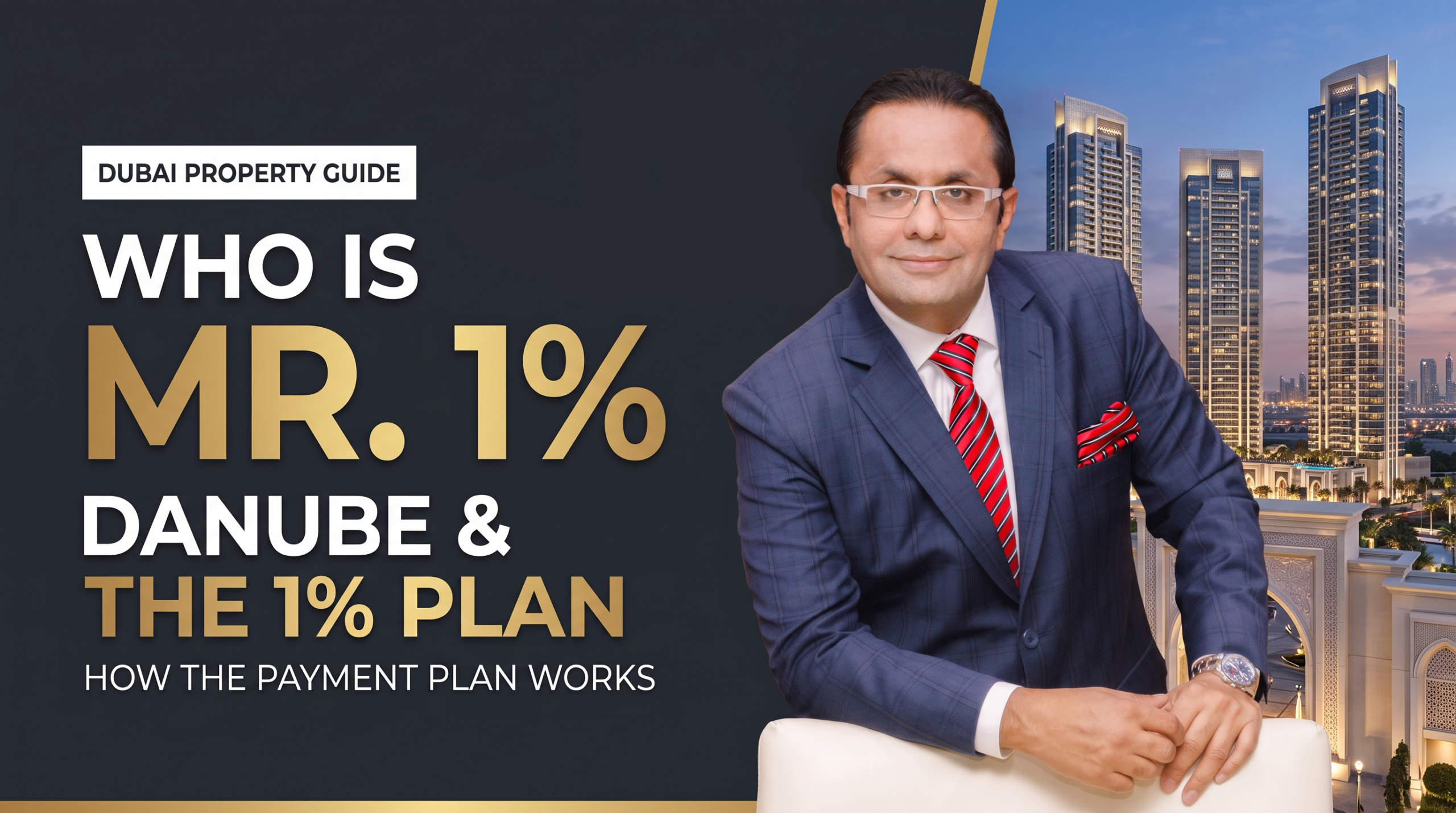
Rizwan Sajan, the founder and chairman of Danube Group, is widely associated with the “Mr. 1%” identity and Danube’s monthly property payment plans. The company’s history begins much earlier.
Danube Group’s official history dates its founding to 1993, when Sajan established a trading business. Building materials became a central part of the group’s activities. Danube’s own account dates its entry into property development to June 2014, more than two decades later.
The sequence illustrates how an entrepreneur can expand from an established operating business into a related industry. It does not reveal the complete composition of Sajan’s personal wealth, or prove a general rule about how other millionaires made their money.
Property development also remains an operating business. It involves acquiring land, managing construction, arranging funding and selling homes. Its responsibilities and risks differ considerably from those of an individual buying one completed apartment to rent out.
For a professional or small-business owner, the transferable lesson is to connect a new investment with a realistic understanding of income, commitments and expertise. A strong business or salary can help fund property ownership; the purchase must still justify its price and remain affordable if circumstances change.
Our guide to Rizwan Sajan and Danube’s 1% payment plans explains the developer’s background and the payment-plan questions buyers should ask.
What a 1% Payment Plan Changes for a Buyer
A developer payment plan spreads purchase payments across specified dates. This can help a buyer align instalments with expected earnings, but it does not determine whether the property is good value.
On a hypothetical AED 1 million purchase, an instalment equal to 1% of the price is AED 10,000. That amount must fit alongside living costs, other debts and any larger contractual milestones.
Danube’s general 1% payment-plan page describes an upfront payment, monthly instalments and a completion balance. Buyers should use the current schedule for the specific unit: post-handover terms, where offered, must be expressly confirmed.
Before committing, map out the deposit, registration and other purchase expenses, monthly instalments, handover balance, furnishing and likely letting costs. Include a period without rental income after completion.
A manageable monthly instalment is useful only if the entire purchase remains manageable. Paying a premium for an attractive schedule can reduce the benefit of spreading the payments.
A Dubai Property Example: From Gross Rent to Net Income
Consider an illustrative cash purchase. These figures explain the calculation; they are not a current property quotation or a forecast of Dubai returns.
| Item | Hypothetical amount |
|---|---|
| Purchase price | AED 1,000,000 |
| Annual rent at full occupancy | AED 80,000 |
| Vacancy allowance | AED 4,000 |
| Service charges | AED 15,000 |
| Maintenance and replacement allowance | AED 6,000 |
| Management, insurance and other owner costs | AED 5,000 |
| Net operating income after these allowances | AED 50,000 |
| Gross yield on purchase price | 8% |
| Net operating yield on purchase price | 5% |
If purchase and setup costs added a hypothetical AED 60,000, the initial cash invested would become AED 1,060,000. The same AED 50,000 income would represent approximately 4.72% of that total.
That AED 60,000 is an assumption, not a standard fee quotation. Obtain an itemised budget for the actual transaction. Financing, investor-specific taxes, major unexpected expenditure and eventual selling costs are excluded from this example.
The distinction matters when comparing properties. Two apartments can advertise the same gross yield while leaving their owners with different amounts to save, spend or reinvest.
Our Dubai property investment guide examines returns, costs and risks in more detail.
Property Value and Personal Equity Are Different
Suppose a property is worth AED 1 million and has an outstanding mortgage of AED 700,000. The owner’s equity is AED 300,000 before selling expenses.
If its value falls to AED 900,000 while the mortgage remains unchanged, equity falls to AED 200,000. A 10% decline in property value has reduced that equity by approximately one-third.
Borrowing can amplify gains as well as losses relative to the buyer’s own capital. Assess affordability under lower rent, vacancy and less favourable financing conditions, rather than relying solely on an optimistic sale price.
How to Apply These Lessons to a Dubai Purchase
Start With the Purpose of the Property
A family home, a rental investment and an off-plan purchase serve different needs. A homebuyer may value stability, layout and commuting time. An income-focused investor needs a realistic view of rent, expenses and tenancy conditions.
A completed property can be inspected and may offer an existing tenancy to assess. A vacant ready property still needs to be let. An off-plan home has a construction period without rental income and requires funding through the contractual milestones.
For off-plan purchases, use the Dubai Land Department’s Project Status Enquiry to check reported completion information. Review the sale agreement, payment instructions and developer delivery history alongside that information.
Evaluate the Building and Unit
An area name is only the starting point. In Dubai Land Residence Complex, for example, compare specific buildings and homes by layout, condition, access, parking, competing rental listings and ownership costs.
Ask for comparable completed transactions and achievable rents for similar units. An asking price is a seller’s expectation; it does not demonstrate what another buyer has paid.
Keep Cash Available Beyond the Deposit
Buying property should leave room for repairs, vacancy, income interruptions and other commitments. The appropriate reserve depends on job stability, borrowing, household responsibilities and the property’s condition.
For business owners, consider whether the money is genuinely available after operating expenses, taxes and working-capital needs. A property deposit should not leave an otherwise healthy company struggling to meet its obligations.
Measure the Full Cost of Ownership
The UAE Federal Tax Authority says income earned by an individual from UAE property investment in their personal capacity will generally not be subject to UAE corporate tax. The treatment of companies and business activities requires separate consideration, and obligations in another tax jurisdiction may also matter.
Tax treatment is one part of the calculation. Service charges, repairs, management, financing and transaction expenses still affect what the owner retains.
Give the Investment a Realistic Time Horizon
A longer hold may provide more rental income and flexibility over when to sell. It also extends exposure to repairs, vacancies and market changes.
There is no fixed anniversary at which costs disappear or profit becomes assured. Our explanation of property holding periods and the Rule of 7 shows why the result depends on the numbers and the treatment of rental income.
The Guardians Prime Perspective
The most useful lesson from successful property owners is the importance of making a purchase work within their wider finances.
Before recommending a shortlist, the questions worth answering are practical: Is the price supported by comparable sales? Is the expected rent achievable? Can the buyer meet every payment without depending on a profitable resale? What remains after ownership costs?
A well-selected property can provide a home, income and exposure to potential growth. Those benefits become clearer when the purchase is assessed on its own merits, with enough financial flexibility to handle an outcome below expectations.
Frequently Asked Questions
Did 90% of millionaires become wealthy through real estate?
The ownership statistic discussed here does not establish that. It reports primary-home ownership within a defined millionaire investor group, rather than identifying how those investors originally accumulated their wealth.
Does owning a million-dirham property make me a millionaire?
It does not establish your total net worth. Deduct outstanding debt and include your other assets and liabilities. Specify the currency too: AED 1 million and US$1 million are different thresholds.
Can a salaried professional build wealth through property?
Yes, it is possible. Savings can fund ownership, while net rent, debt reduction and changes in value may contribute over time. Results depend on the purchase price, expenses, financing and market performance.
What does Rizwan Sajan’s story teach property buyers?
His expansion from building materials into property development illustrates a move into a related business after years of operating experience. It does not establish a universal investment formula or predict the outcome of buying a Danube property.
Can tenant rent cover a developer’s post-handover instalments?
It may cover part or all of them, depending on the actual schedule and net rental cash received. Check payment dates as well as annual totals, and retain funds for vacancy, expenses and delayed rent.
Is renting a waste of money if I want to build wealth?
Rent pays for accommodation and flexibility. Compare buying and renting over your expected time in the home, including ownership expenses, transaction costs and what your deposit could otherwise fund.
Build a Property Plan Around Your Own Numbers
The percentage of millionaires who own homes cannot tell you which property to buy. Your available capital, income needs, ownership costs and ability to manage uncertainty can.
If you are considering a Dubai home or investment property, contact Guardians Prime Real Estate. Share your budget, preferred timeline and income goals so our team can help you compare available properties, payment schedules and realistic ownership costs.